Why Crystal Prices Differ From the In-Game Store
The smallest Genesis Crystal listing on KeyGold is $0.77 against a $0.99 list price, and the largest single pack is $74.99 against $99.99 — the gap comes from the per-game discount published on the store's home page, not from a different pack. This page walks the published ladder, shows the arithmetic behind each difference, and explains what a buyer has to supply in return.

Key takeaways
- Genshin Impact shows a 28% discount row on the store home page.
- The pages state that top-ups cost 15–30% less than the in-game price across the catalogue.
- On the 980+110 listing the difference is $4.16, and on the 6480+1600 listing it is $25.00.
- Prices are quoted in USD; pay in another currency and your bank may add its own conversion fee.
Where the price gap comes from
A buyer comparing two tabs usually sees the same crystal counts on both: 60, 300+30, 980+110, 1980+260, 3280+600, 6480+1600. The pack contents are identical because the purchase itself happens in the game's own shop. What differs is the amount charged for arranging that purchase, and the store publishes a discount per game on its home page. Genshin Impact is listed at −28%, Arknights: Endfield at −25%, Whiteout Survival at −18%, Wuthering Waves at −28% and Mobile Legends: Bang Bang at −47%.
A separate line on the game pages makes the same point in round terms: top-ups are stated to cost 15–30% less than the in-game price. That band and the per-game percentage are two ways of describing the same shelf. Neither is a formula I can apply to an arbitrary pack, so the honest way to read them is to look at the two figures printed beside each listing and subtract.
KeyGold is a third-party top-up store, not a publisher or an official channel, and the pages say so. The account used for delivery is a HoYoverse Account. Nothing about the in-game bonus changes, because the store buys the pack inside the game's shop exactly as a player would; the published material states that in-game bonuses apply the same way as a self-purchase.
The published ladder, price by price
The table below takes five rungs of the Genshin Impact ladder and does the subtraction. The last column is my own calculation from the two published figures; everything else is printed on the page.
| Pack (crystals) | KeyGold price (US$) | List price (US$) | Difference (US$) | Difference (%) |
|---|---|---|---|---|
| 60 | 0.77 | 0.99 | 0.22 | 22.2 |
| 300+30 | 3.60 | 4.99 | 1.39 | 27.9 |
| 980+110 | 10.83 | 14.99 | 4.16 | 27.8 |
| 3280+600 | 36.12 | 49.99 | 13.87 | 27.7 |
| 6480+1600 | 74.99 | 99.99 | 25.00 | 25.0 |
The percentage column is the interesting one. It stays in a narrow band between roughly a quarter and three tenths of the list price, which is what a shelf-wide discount looks like. The one outlier is the largest single pack, and the reason is simple: $74.99 against $99.99 is a smaller proportional step than $0.77 against $0.99, even though the cash difference is a hundred times larger.
Worked example: cost per crystal on two rungs
Cost per crystal is the cleanest way to compare packs of different sizes, and the arithmetic is short. These are my own workings, using the published prices.
The 980+110 pack. Contents: 980 base + 110 bonus = 1090 crystals. At the store price, 10.83 ÷ 1090 = $0.00994 per crystal. At the list price, 14.99 ÷ 1090 = $0.01375 per crystal. The difference per crystal is 0.01375 − 0.00994 = $0.00381, so the store price is 0.00381 ÷ 0.01375 = 27.7% lower — the same figure as in the table above, reached by a longer road.
The 6480+1600 pack. Contents: 6480 + 1600 = 8080 crystals. Store price: 74.99 ÷ 8080 = $0.00928 per crystal. List price: 99.99 ÷ 8080 = $0.01238 per crystal. The gap per crystal is 0.01238 − 0.00928 = $0.00310, or 25.0% of the list figure.
Two caveats belong with that arithmetic. Genesis Crystals convert to Primogems one for one and a Wish costs 160 Primogems, so the cost per crystal can be turned into a cost per Wish, but only under that assumption. And the ladder is not linear: the 60-crystal rung is deliberately a top-up, not a bulk buy, so its percentage discount is the weakest of the five rows above.
Three rungs shown side by side
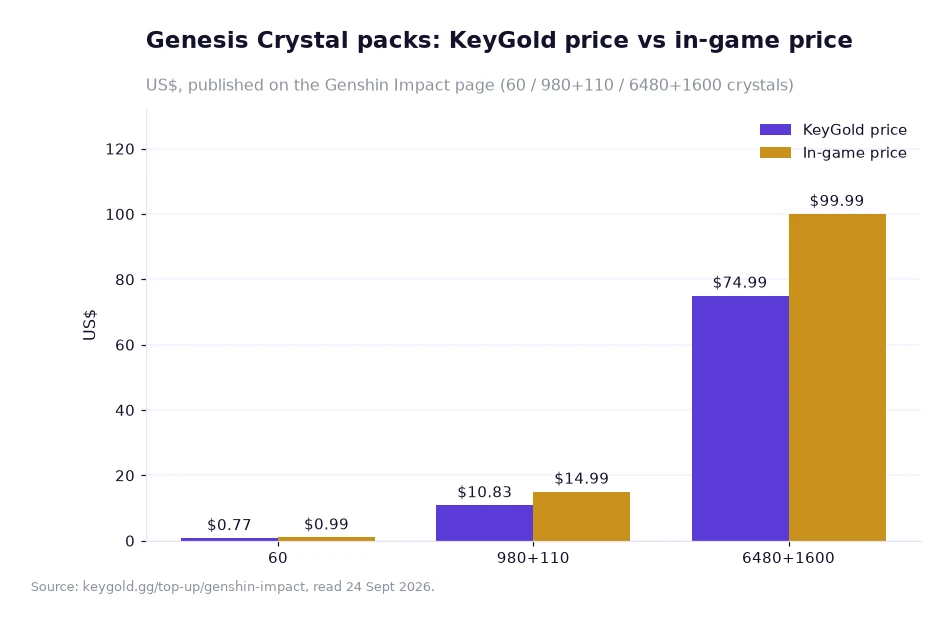
The chart repeats three of those rows as a bar pair, one bar for the store price and one for the list price. It is the quickest way to see that the discount is a shelf-wide percentage rather than a special offer on a single pack.
Prices are shown in US dollars on the store, and the header carries a currency selector, so the amount you pay may be converted at checkout. If your card is billed in another currency, your bank may add its own conversion fee on top; that charge comes from the bank, not from the store. The currency selector is the published answer to that, and it does not change the underlying dollar figures discussed here.
What the price buys you in service
A cheaper pack is only worth comparing if the rest of the order holds up, and the pages are specific about the trade. Delivery on the Genshin Impact page is 5–30 minutes and runs around the clock; queues stretch in the first hours of a new banner, and only one active session per account is allowed, so the instructions ask you to log out while the order is processed. You supply the HoYoverse Account email, its password and the server your character is on, from the four supported servers: America, Europe, Asia and TW-HK-MO.
If you want to check whether the game you play carries a similar gap, the store's game index lists every title with its discount, and the top-up index links each one to its own page. Reading those two pages takes a minute and tells you whether you are comparing a discounted shelf or a full-price one.
Support is a live chat staffed by a real person 24/7, before and after the purchase. Order status sits in the Order Record at any time, and a confirmation email arrives when the order completes. The site publishes a Full Refund Guarantee: if an order is not delivered or cannot be used, you receive a full refund. First-time buyers can claim the new-user coupon — 15%, one coupon, no threshold, valid 30 days. The page that lists all of this in one place, pack by pack beside the list prices, is the one people reach for when they type cheap genshin top up into a search box.
Frequently asked questions
Why is the pack cheaper here than in the game shop?
The store publishes a per-game discount on its home page, 28% for Genshin Impact, and prints its price beside the list price on each listing, so the difference is visible before you order rather than explained afterwards.
Does a cheaper pack mean fewer crystals or a different bonus?
The listings carry the same crystal counts as the game shop, such as 980+110 and 6480+1600, and the pages state that in-game bonuses are applied the same as a self-purchase, so the pack itself does not shrink.
Checking a price before you commit
Open the game's shop on one tab and the store page on the other, then compare the two figures printed for the same crystal count. Multiply by the pack size if a cost-per-crystal figure helps you decide, and remember that the discount is a percentage of the list price rather than a fixed saving. If the number you see on the store page ever looks higher than the list price beside it, treat that as a reason to ask in the live chat before paying. Everything else — delivery window, refund wording, coupon terms — is stated in the same place and can be read in a couple of minutes.
There is one more check worth doing before the arithmetic convinces you. A percentage discount is only as useful as the baseline it is measured against, and the baseline here is the list price printed on the same page. If you have never bought crystals before, start with the smallest rung and watch the order complete in the Order Record; the delivery window and the process are the same at any size, so the first order is the sensible place to test the workflow. Once you know the flow, the cost-per-crystal column above is the only number you need to compare one pack against another. The store also keeps a blog with shorter write-ups if you want a second explanation of the same ladder.
Prices, list prices, discounts, delivery windows, coupon terms and refund wording are taken from KeyGold's own pages, read 24 Sept 2026; the differences and cost-per-crystal figures are my own arithmetic on those published numbers.[1]