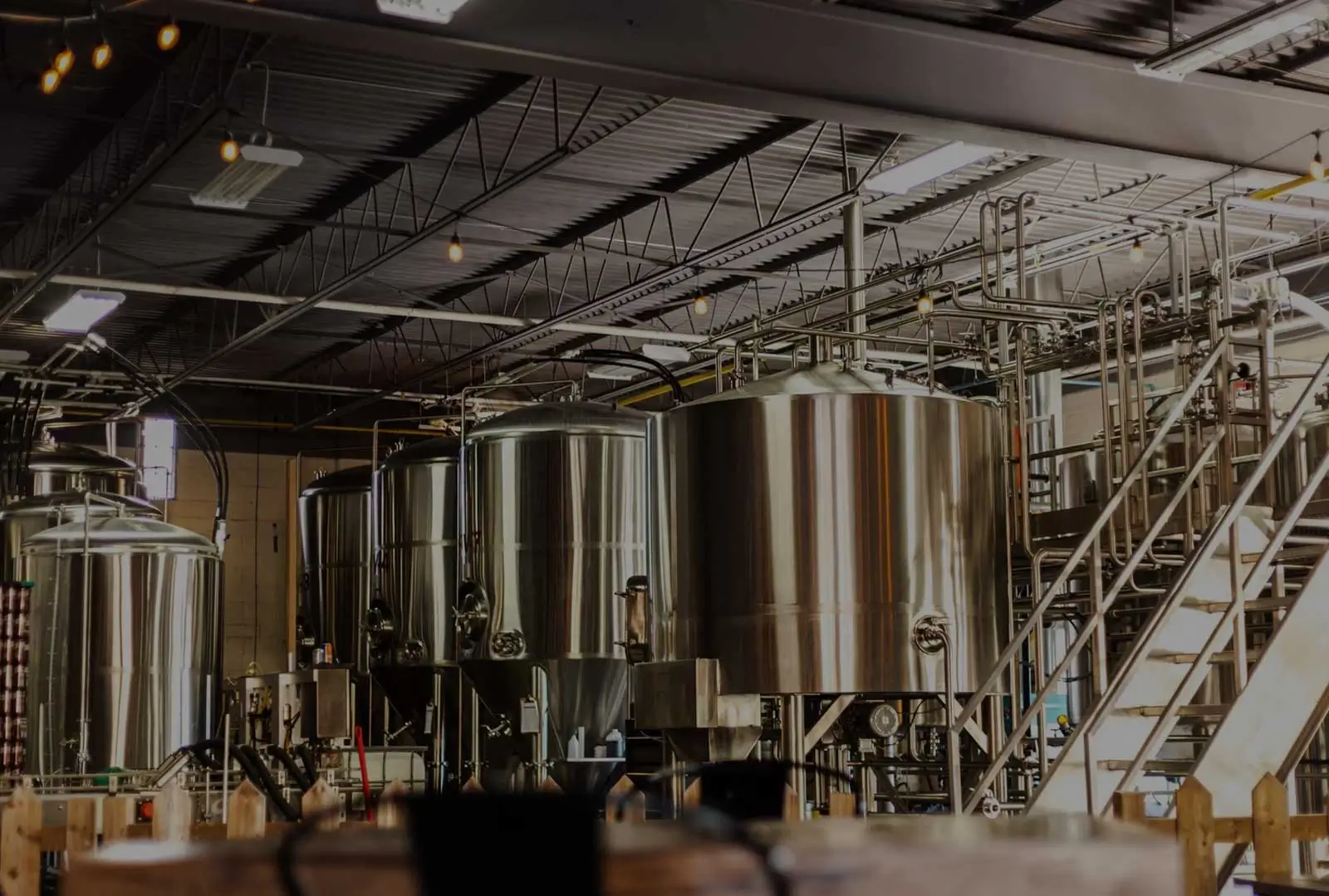
A craft brewery needs more than a fermenter to manage beer fermentation reliably. A complete setup normally includes stainless-steel cylindroconical tanks, glycol cooling, temperature controls, pressure hardware, yeast-handling equipment, wort oxygenation, CIP cleaning, sanitary pumps, hoses, CO₂ supply, and basic quality-control instruments. Commercial ale fermentation commonly runs around 18–22°C, while lager fermentation may begin near 8–14°C. Tank working volume is normally lower than total vessel volume because active fermentation needs headspace, often around 20–25%. For a 1,000 L batch, equipment selection must also account for cooling demand, fermentation time, cleaning time, pressure rating, and weekly production volume.
Most modern craft breweries use stainless-steel cylindroconical fermenters because one vessel can support fermentation, yeast settling, cold conditioning, and, when pressure-rated, carbonation. A 1,000 L brewhouse may use a fermenter with roughly 1,200–1,300 L total internal capacity so that foam and CO₂ production do not fill the entire vessel during active fermentation.
Tank geometry matters as much as nominal volume. A cone angle around 60° is common because settled yeast and hop solids can move toward the bottom outlet without requiring the brewery to transfer the beer immediately. The operator can dump sediment, collect yeast, take samples, and continue conditioning in the same vessel.
A tank sold as “1,000 L” should be checked carefully: suppliers may refer to working volume, nominal volume, or total volume, and those three figures are not always the same.
Material specification also deserves attention. 304 stainless steel is widely used for beer-contact surfaces because it works well with normal brewery cleaning chemicals and sanitary fabrication methods. Internal welds should be smooth and accessible to cleaning solution, while fittings should avoid pockets where beer, yeast, or caustic solution can remain after a cleaning cycle.
Once the vessel size is established, temperature control becomes the next equipment requirement. Fermentation produces heat, and the heat generated by yeast becomes harder to remove as batch size increases. A homebrew fermenter may follow room temperature reasonably closely, but a 10 hL or 20 hL commercial tank can rise several degrees during active fermentation without external cooling.
Jacketed tanks solve that problem by circulating chilled glycol around selected sections of the vessel. A typical brewery cooling loop contains a glycol chiller, reservoir, circulation pump, insulated piping, solenoid valves, temperature probes, and individual tank controllers. Many systems use propylene glycol mixed with water at concentrations around 25–35%, depending on the required coolant temperature and equipment manufacturer's recommendation.
Temperature requirements change during the production cycle. An ale might ferment near 19–21°C, then be cooled gradually before cold conditioning. Beer intended for clarification and carbonation may later be brought close to 0–3°C. Moving a full 1,000 L vessel through that temperature range can require far more refrigeration capacity than simply maintaining fermentation temperature.
| Equipment area | Typical specification to review | Why it matters |
|---|---|---|
| Fermenter | 10–25% headspace above working volume | Allows room for foam and gas |
| Cooling | 25–35% glycol mixture in many systems | Supports low coolant temperatures |
| Ale fermentation | About 18–22°C | Common range for many ale strains |
| Cold conditioning | About 0–3°C | Helps settling and carbonation |
| Tank pressure | Manufacturer-rated operating pressure | Determines permitted pressure use |
| CIP | Flow, temperature, chemical concentration | Affects repeatable tank cleaning |
Cooling capacity should therefore be calculated from simultaneous demand rather than tank count alone. If six 1,000 L tanks are installed, all six will not necessarily need maximum cooling at the same time, but several may overlap during fermentation, cold crashing, or packaging preparation. Breweries built in 2026 should also leave realistic refrigeration capacity for planned tank additions rather than sizing only for the first production month.
Temperature control naturally leads to pressure management because fermentation produces CO₂ continuously. A pressure-rated unitank can retain part of that CO₂, support spunding, allow carbonation, and feed some packaging systems without transferring beer to another vessel. The manufacturer's allowable working pressure must govern operation; nominal tank shape or wall thickness should never be used to guess a safe pressure.
A basic pressure arrangement may include:
-
a calibrated pressure gauge;
-
pressure-relief and vacuum-protection devices;
-
an adjustable spunding valve;
-
sanitary gas connections;
-
a CO₂ regulator and gas manifold;
-
pressure-rated clamps, gaskets, and valves.
Many craft unitanks are designed for low-pressure brewery service rather than high-pressure industrial gas storage. Exact ratings vary by manufacturer and market, so a brewery should compare design pressure, working pressure, test pressure, and local pressure-vessel requirements before ordering. A vessel operating 5–7 days under pressure needs the same attention to fittings and relief hardware as the tank body itself.
Pressure equipment supports the vessel, while yeast equipment supports the biological side of fermentation. Yeast pitch rate, viability, temperature, wort gravity, and oxygen availability all influence fermentation speed and flavor formation. A small brewery may pitch directly from prepared containers; a larger operation may use a dedicated yeast brink or propagation vessel.
For reused yeast, sanitary collection matters. The cone allows the operator to remove early sediment and later harvest a cleaner yeast fraction. Some breweries evaluate cell concentration and viability with a microscope and counting chamber before repitching. A sample containing 100 or more counted cells can give a more useful estimate than judging yeast condition only by appearance, although the brewery's laboratory method should remain consistent from batch to batch.
Yeast preparation connects directly with wort oxygenation. Before fermentation starts, yeast needs oxygen for membrane synthesis and healthy growth. Oxygen may be introduced through filtered air or pure oxygen using sanitary tubing and a diffusion stone. The appropriate level depends on wort gravity, yeast strain, pitching condition, and process design rather than a single fixed number for every beer.
After fermentation has progressed, the approach reverses. Oxygen exposure should be kept low because finished beer is much more sensitive to oxidation. Closed transfers, purged hoses, CO₂-purged receiving vessels, and properly sealed sample points can reduce oxygen pickup. Some packaging-focused breweries target dissolved oxygen in finished beer at levels measured in tens of parts per billion rather than percentages.
That low-oxygen approach places more importance on sanitary transfer equipment. Pumps, hoses, valves, clamps, gaskets, sight glasses, and sample valves may appear secondary beside a 2,000 L fermenter, yet every product-contact component becomes part of the hygienic system. One poorly cleaned hose or damaged gasket can expose an entire batch to unwanted microorganisms.
Connection standards should therefore be simplified where possible. Using the same sanitary fitting family across fermentation, transfer, and CIP lines reduces spare-parts inventory and lowers the chance of connecting incompatible components. A brewery with 12 fermenters may otherwise accumulate dozens of gasket sizes, reducers, adapters, and clamp combinations that slow routine work.
Cleaning equipment follows the same logic. Fermentation leaves yeast, protein, hop particles, mineral residue, and beer stone on internal surfaces. A commercial CIP arrangement normally uses a pump, chemical tank or cart, heating where required, sanitary hoses, and a spray device inside each vessel.
A cleaning cycle may include a pre-rinse, alkaline wash, intermediate rinse, acid treatment when required, and sanitation before production. Chemical strength varies by product and supplier; many brewery caustic cleaners are used at concentrations measured in low single-digit percentages, often around 1–3%, with temperature and contact time adjusted to soil level and chemical instructions.
Cleaning performance depends on four variables working together: chemistry, temperature, mechanical flow, and contact time. Raising one variable does not automatically compensate for poor performance in another. A 30-minute circulation with inadequate flow can leave areas of the tank less effectively cleaned even when chemical concentration is correct.
CIP design should therefore be matched to vessel geometry and pipe resistance. A pump that works well on a 500 L tank may not provide suitable spray performance in a 5,000 L vessel with longer pipe runs. When breweries compare Turn-Key brewery solutions, checking CIP pump sizing, glycol capacity, piping layout, and utility requirements together is more useful than comparing fermenter price alone.
CO₂ equipment becomes more important after cleaning and fermentation because it supports purging, pressure transfer, and carbonation. A typical arrangement includes a bulk or cylinder CO₂ source, regulator, gas manifold, sanitary hoses, tank connections, and, where required, a carbonation stone.
Carbonation depends strongly on temperature and pressure. Colder beer absorbs CO₂ more readily, which is why breweries often carbonate after cooling beer close to 0–3°C. Desired carbonation varies by beer style, but many commercial beers fall broadly around 2.2–2.7 volumes of CO₂. Equipment must allow the brewer to reach the required level without exceeding vessel pressure limits.
CO₂ also creates an occupational-safety issue. It is colorless and can collect in low areas because it is denser than air. Fermentation rooms, cold rooms, and enclosed cellars may therefore require ventilation and fixed CO₂ monitoring. OSHA's 8-hour permissible exposure limit for carbon dioxide is 5,000 ppm, or 0.5%, providing a useful reference when planning brewery ventilation and monitoring.
Measurement equipment completes the fermentation system. A brewery cannot manage fermentation consistently if operators rely only on time and visual activity. Density or specific gravity, temperature, pH, pressure, sensory checks, and yeast condition provide much better information about whether a batch is progressing as expected.
A basic quality-control bench may use a hydrometer or digital density meter, calibrated thermometer, pH meter, microscope, counting chamber, and carbonation-testing equipment. Breweries with tighter packaging specifications may add dissolved-oxygen meters because oxygen levels below 100 ppb can matter to shelf stability, especially for packaged hop-forward beer.
Production planning should finally connect every item back to tank occupancy. If a brewery produces 1,000 L per brew and a beer occupies a fermenter for 14 days, one tank cannot support a fresh 1,000 L batch every brewing day. Six tanks provide 6,000 L of nominal batch positions, but fermentation time, cleaning turnaround, dry hopping, conditioning, and packaging schedules determine actual monthly output.
Adding larger tanks can change that balance. A 2,000 L fermenter may receive two 1,000 L brews, reducing the number of vessels required per production volume, but it also increases cooling demand, transfer planning, yeast requirements, and the amount of beer tied to one vessel. A problem affecting one 2,000 L batch also involves twice the beer of a 1,000 L batch.
For that reason, equipment selection should be based on weekly brews, average tank residence time, beer mix, packaging frequency, available floor area, ceiling height, cooling capacity, and expected growth over the next 2–5 years. Fermenters, glycol systems, CIP equipment, gas supply, yeast handling, and quality-control tools should be sized from the same production schedule rather than purchased as unrelated pieces of equipment.