When the Power Bill Lands Before the Payout: Borrowing Against Mined Coins
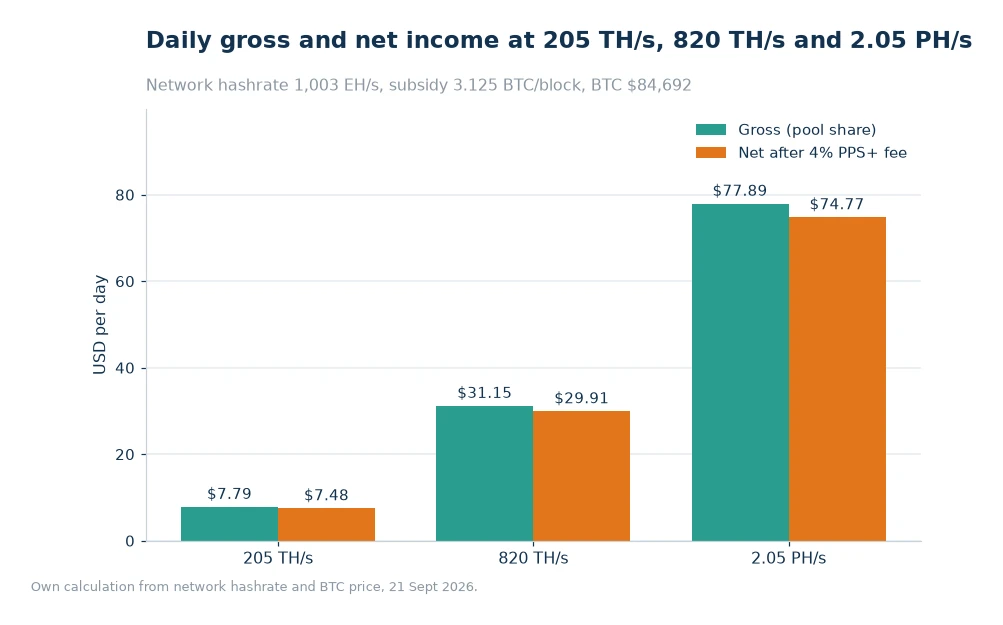
Mining pays in drips while utilities bill in lumps, and the gap between the two forces hard choices. At 205 TH/s the daily gross is $7.79, netting $7.48 after the listed 4% on the block-reward component; at 2.05 PH/s the day nets $74.77. This piece maps those income tiers against a borrowing option built for miners: pledging coins instead of selling them.

Key takeaways
- 205 TH/s grosses $7.79 daily and nets $7.48; 820 TH/s grosses $31.15 and nets $29.91.
- 2.05 PH/s grosses $77.89 a day and nets $74.77 at BTC $84,692.
- Collateral-Pledged Loans let miners borrow against holdings through a five-step flow without selling the stack.
- Daily income of $74.77 covers a $500 power bill in under seven days of hashing.
The timing gap every miner meets
Electricity meters spin continuously while pool credits accumulate a few dollars a day. A 205 TH/s rig netting $7.48 daily needs over two months to cover a single $500 invoice, and even the 820 TH/s shelf at $29.91 a day needs seventeen days. The coins exist; they simply arrive slower than the bills. Selling a chunk of the stack closes the gap at the cost of the future upside that motivated mining in the first place.
Borrowing against the mined balance offers a middle path. Instead of liquidating coins at whatever price the bill date dictates, the miner pledges them, draws cash or stable value for the invoice, and reclaims the collateral when income catches up. The strategy suits anyone whose objection to selling is timing rather than need: the power company gets paid this week, and the coins stay positioned for later.
Three income tiers that set the loan size
The chart fixes the borrowing capacity discussion in dollars. The 205 TH/s tier nets $7.48 a day, about $224 a month, which supports only modest short-term borrowing. The 820 TH/s tier nets $29.91 daily, near $897 monthly, enough to smooth quarterly invoices with room to spare. The 2.05 PH/s tier at $74.77 a day, roughly $2,243 a month, can carry serious facility costs while keeping pledged collateral comfortable.
Gross figures sit just above: $7.79, $31.15, and $77.89 respectively, with the gap representing the listed 4% on the PPS-settled block-reward component. Lenders look at net when sizing, so quote the net column on any application. A loan sized against gross borrows against money that never arrives, and repayment schedules built on fantasy default on schedule.
How pledging coins works in five steps
The ViaBTC Crypto Loan desk structures Collateral-Pledged Loans as a short sequence: Add Collateral, then Apply for Loan, then Receive Loan, followed later by Repay Loan and Redeem Collateral. Each step is explicit, so the miner always knows whether coins are pledged, borrowed against, or free. The collateral stays visible in the account through the whole cycle rather than vanishing into an opaque vault.
That visibility matters for miners because the pledged asset keeps earning its narrative weight. Coins mined at 2.05 PH/s accumulate $74.77 of net value daily even while an earlier tranche sits pledged; incoming credits can top up collateral or service interest without touching the original principal. Plan the pledge ratio conservatively so a normal price dip triggers a top-up notice rather than a forced sale.
Sizing the pledge against the power bill
Translate the invoice into days of net income before pledging anything. A $500 bill represents 67 days at the 205 TH/s tier, 17 days at 820 TH/s, and under 7 days at 2.05 PH/s. Borrow only the invoice amount plus a buffer for the next meter reading, never the maximum the collateral allows. Maximum borrowing converts a timing tool into leverage, and leverage has opinions about price drops.
The Profit Calculator keeps the sizing honest as difficulty moves. Recompute the $7.48, $29.91, and $74.77 nets whenever an adjustment larger than a few percent lands; a 10% difficulty rise trims each tier proportionally and lengthens every days-of-income conversion. Loans sized in dollars must be rechecked in difficulty, not just in coin price.
Repayment discipline for drip income
Drip income repays best on autopilot. Direct a fixed share of each week's credits, say half the 820 TH/s tier's $209 weekly net, toward the loan while living costs take the remainder. Fixed-percentage repayment flexes with difficulty automatically: lean weeks pay less, strong weeks pay more, and the schedule never demands money the rigs did not earn.
Set two guardrails in advance. First, a price floor at which extra collateral goes in without debate, chosen before pledging while judgment is cool. Second, a latest-repayment date tied to the next large invoice, so one bill never cascades into two. The multi-currency wallet holding both the mined coins and the borrowed balance in one account makes these transfers a matter of clicks rather than exchange queues.
Tax records deserve a parallel folder from the first pledge. Borrowing against coins and later repaying creates events a future return must describe accurately, and the loan history exports provide the dates and amounts. A miner who files each quarter spends an hour; one who reconstructs two years spends a weekend with an accountant. Boring folders beat interesting audits.
| Mining tier | Gross per day | Net per day | One week of net |
|---|---|---|---|
| 205 TH/s | $7.79 | $7.48 | $52.36 |
| 820 TH/s | $31.15 | $29.91 | $209.37 |
| 2.05 PH/s | $77.89 | $74.77 | $523.39 |
The rightmost column is the practical one: weekly net is what actually meets bills and services loans. At the top tier a single week covers a $500 invoice with change; at the bottom tier the same invoice needs ten weeks. Borrow against the week you have, not the month you hope for.
Worked example
Derive all three tiers from network inputs and show how many days each needs for a $500 invoice.
- Per-TH/s day rate: 450 ÷ 1,003,000,000 = 0.00000044865 BTC.
- 205 TH/s: 205 × 0.00000044865 = 0.00009197 BTC; × 84,692 = $7.79 gross; × 0.96 = $7.48 net.
- 820 TH/s: 820 × 0.00000044865 = 0.00036789 BTC; × 84,692 = $31.15 gross; × 0.96 = $29.91 net.
- 2.05 PH/s is 2,050 TH/s: 2,050 × 0.00000044865 = 0.00091964 BTC; × 84,692 = $77.89 gross; × 0.96 = $74.77 net.
- Weekly nets: $7.48 × 7 = $52.36; $29.91 × 7 = $209.37; $74.77 × 7 = $523.39.
- Days per $500 bill: 500 ÷ 7.48 = 66.8 days; 500 ÷ 29.91 = 16.7 days; 500 ÷ 74.77 = 6.7 days.
- Fee slice at the top tier: $77.89 − $74.77 = $3.12 a day on the block-reward component.
- Borrowing $500 against $74.77 daily net means the income replaces the principal in under a week of hashing.
Frequently asked questions
What are the five steps of the loan flow?
Add Collateral, Apply for Loan, Receive Loan, Repay Loan, then Redeem Collateral. The sequence keeps pledged coins visible throughout, and each step completes before the next begins.
How much should a 205 TH/s miner borrow?
Only the invoice at hand plus a small buffer. At $7.48 net a day the tier earns $52.36 a week, so borrowing should stay near single-bill scale with repayment mapped in weeks, not months.
What happens if the coin price falls while coins are pledged?
The collateral value falls with it, which can trigger a top-up request. Pledge conservatively from the start and keep incoming credits ready to reinforce the position before any deadline pressure.
Pay the bill, keep the coins
Match the tier to the invoice, borrow the invoice and no more, and let the rigs repay on a fixed percentage. The $74.77 top-tier day makes this comfortable; the $7.48 starter day makes it a discipline. Either way the principle holds: timing gaps are financing problems, and financing problems have cheaper solutions than selling the stack at the wrong week.
Review the current terms on the loan page before pledging, confirm the listed fee treatment behind your net figures, and write the two guardrails down. Bills paid, collateral redeemed, ledger intact: that is the whole ambition.
Sources: the ViaBTC loan, wallet, and calculator pages for the pledge flow and income inputs[1]. Chain data read 21 Sept 2026: 1,003 EH/s network, 132.76 T difficulty, 3.125 BTC subsidy, 144 blocks daily, BTC $84,692. Figures published 11 Nov 2026; income assumes steady difficulty and full uptime before power costs.