RWD or AWD? Choosing a Drivetrain Down Under
XPENG sells the New G6 in Australia as a rear-wheel-drive Long Range or as an all-wheel-drive variant, and the only published performance figure that separates them is a 0 to 100 km/h time of 4.13 s for the AWD. Everything else a buyer weighs — wet-road confidence, gravel driveways, a trailer on the back — comes down to how the car puts its power down rather than how fast it is. Here is what the published specification can settle, and what only a test drive will.

Key takeaways
- Two variants are named on the Australian pages: the New G6 RWD Long Range and the New G6 AWD.
- The published 0 to 100 km/h figure is 4.13 s, and it is attributed to the all-wheel-drive car.
- WLTP range for the New G6 line is published as up to 525 km, not per variant.
- Both variants use the full-domain 800V silicon carbide platform with 5C supercharging.
What the two variants actually differ on
Start with the parts of the specification that are identical, because they remove most of the bargaining. Both variants sit on the same 800V silicon carbide platform, both are described with 5C supercharging, and both are credited with a 10 to 80 per cent state of charge window of 12 minutes. The charge flap is on the right rear quarter panel of the car in either case.
The published differences are narrower than the marketing language suggests. The AWD carries a 4.13 s figure for the standing 0 to 100 km/h sprint. The RWD Long Range variant is the car XPENG used for its own internal test that produced 427 km of charge added in 15 minutes.
That internal test figure is worth noting precisely because of what it is. It is not a WLTP number and it was not measured on a public charger on a Tuesday. It is a useful indication of what the platform can do when the conditions cooperate, and it arrives with a footnote naming the exact variant and the test method.
Where all-wheel drive earns its keep in Australia
Australia is a country of specific traction problems rather than general ones. A steep concrete driveway that turns wet in July, a gravel road to a farm gate, a boat ramp with algae on the last metre, a camping access track that has just been graded. None of these need a faster car; they need two axles sharing the work.
Rear-wheel drive is not a disadvantage on sealed roads, and the majority of Australian driving happens on sealed roads in dry or lightly wet conditions. Where the rear-drive layout loses ground is at very low speeds on loose surfaces, and when the car is pulling weight that wants to push rather than follow.
If your year includes towing a trailer, launching at a ramp, or a regular unsealed driveway, the AWD variant is the one to drive first. If your driving is a city commute and the occasional highway trip, the RWD Long Range is the variant whose published range and internal test figure most directly answer your questions.
Published figures and the conditions attached to them
| Published claim | Figure | Condition attached |
|---|---|---|
| WLTP range | Up to 525 km | Test conditions apply, not a promise for your route |
| 10 to 80 per cent state of charge | 12 minutes | 5C battery on a rapid DC charger |
| Charge added in 15 minutes | 427 km | XPENG internal test of the G6 RWD Long Range |
| 0 to 100 km/h | 4.13 s | Attributed to the all-wheel-drive variant |
| Key parts warranty | 8 years or 160,000 km | Traction battery, battery management, drive motor and power unit |
Two things are missing from that table, and a careful buyer notices them. There is no published range figure per variant, and there is no published towing capacity on the Australian pages. Ask a dealer to confirm what applies to the car you are quoting, in writing, before you arrange a towbar or a trailer.
Rear-wheel drive, traction and regeneration
Regeneration is where a lot of drivetrain conversations go off the rails. Slowing down by recovering energy is a feature of any electric drivetrain, and the Australian pages do not publish a separate regeneration figure for each variant. Treat any claim that one layout recovers meaningfully more energy than the other as unverified until a dealer shows you the documentation.
What you can reason about is the feel. A rear-drive car under acceleration shifts weight off the front axle, which reduces front grip; an all-wheel-drive car spreads the demand across both axles and is less likely to ask a single pair of tyres for more than they have. On a wet roundabout at moderate speed, that difference is subtle rather than dramatic.
The honest answer to the regeneration question is that the driving style you adopt will change your consumption more than the variant badge will. Long, smooth deceleration into lights is worth more than any published distinction between the two cars.
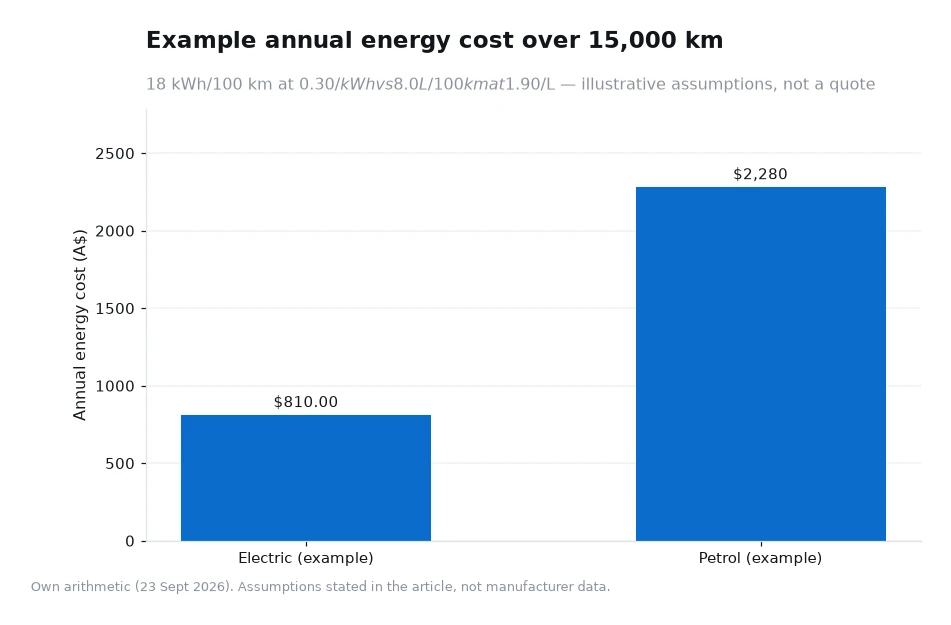
Worked example: annual energy cost over 15,000 km
This is an illustrative calculation with every input stated, and it compares an electric drivetrain with a petrol one so the arithmetic has a reference point. No price or consumption figure for any XPENG vehicle is published on the Australian site, so nothing below is a manufacturer number or a quote.
Assumptions: 15,000 km a year, electricity at 30 cents per kilowatt hour, an electric car using 18 kWh per 100 km, petrol at 1.90 dollars a litre, and a petrol car using 8.0 L per 100 km.
Electric first. 15,000 km divided by 100 gives 150 units of 100 km. Then 150 x 18 kWh equals 2,700 kWh for the year. At 30 cents per kWh, 2,700 x 0.30 equals 810 dollars. Per 100 km that is 18 x 0.30, or 5.40 dollars.
Petrol next. 150 units of 100 km x 8.0 L equals 1,200 litres for the year. At 1.90 dollars a litre, 1,200 x 1.90 equals 2,280 dollars. Per 100 km that is 8.0 x 1.90, or 15.20 dollars. The difference over the year in this example is 2,280 minus 810, which is 1,470 dollars.
Towing, driveways and the questions a dealer can answer
Towing changes the drivetrain question because the mass is behind the car rather than over it. Ask what the manufacturer publishes for the version you are buying, and ask whether a towbar fitted after delivery affects any warranty condition. Get the response in writing alongside your formal quote.
Then take the test drive somewhere that matters. Drive the AWD car up your own driveway if the dealer allows it. Reverse a trailer if you can arrange it, or at least ask to see the towing documentation. Set the mirrors the way you would at home and sit in traffic, because a drivetrain you cannot feel in a five kilometre loop is not a drivetrain you can judge from a brochure.
Variant availability is best confirmed with a dealer, since the Australian line-up also includes the X9 seven-seater and the L03, which is listed as coming soon on the manufacturer's Australian pages. You can review the X9 specification for comparison, then book time in both cars through the official Test Drive booking page.
Frequently asked questions
Is the AWD faster than the rear-wheel-drive New G6?
XPENG publishes a 0 to 100 km/h time of 4.13 s for the all-wheel-drive New G6, and no equivalent published figure for the rear-wheel-drive Long Range variant. On the published record, the all-wheel-drive car is the one with a quoted acceleration time.
Should I choose the RWD or the AWD for a country property?
The all-wheel-drive variant is the one to test if your driving includes loose or unsealed surfaces, a steep wet driveway or towing. Where the Australian pages publish no per-variant range or towing figure, confirm the detail in writing with a dealer before you commit.
How to decide in one dealership visit
Write down your three most demanding journeys before you go. For most people that is a wet hill, an unsealed driveway and one loaded highway trip with the whole family aboard. Drive the variant that seems the compromise, then drive the other, and use your own routes as the standard.
The published specifications for both drivetrains, the platform, the battery and the ownership terms come from the manufacturer's Australian pages, where the model library also covers the XPENG electric suv range in full detail.
All manufacturer figures in this article come from the Australian model pages at xpeng.com/au, read on 23 Sept 2026; WLTP range depends on conditions and the 15-minute charge figure is an internal XPENG test of the RWD Long Range variant. Information in this article is general in nature and does not take into account your personal circumstances. [1]