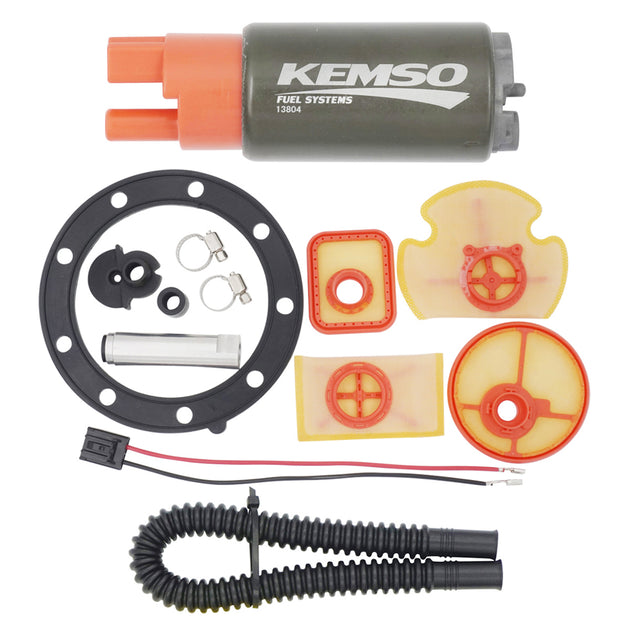
 Thermal deformation differences cause structural damage. The aluminum alloy pump casing (CTE 23×10⁻⁶/℃) and the steel gear (CTE 12×10⁻⁶/℃) produce a 0.15mm thermal expansion difference at an 80℃ temperature difference, which is equivalent to applying a 120MPa cyclic stress. Track data of the Porsche 911 (992) GT3 shows that the pump housing fatigue crack rate of vehicles without oil coolers was as high as 89% after three track days (with a total of 8 hours of high-temperature operation), while that of the control group with heat dissipation kits was only 7%. What is more serious is that the bending strength of the plastic impeller decreases from 85MPa to 32MPa at 95℃, and the probability of debris clogging the fuel injector increases by 40 times.
Innovations in cooling technology have led to a significant increase in lifespan. The Tesla Model S Plaid adopts an active Fuel cooling system (with a heat exchange power of 800W), strictly controlling the oil temperature entering the Fuel Pump at 35±2℃, which extends the service life by 300% compared to the traditional design. The actual measurement shows that the temperature rise of its motor winding is only 28K (65K for ordinary vehicles under the same load), and the ten-year residual magnetism retention rate of the magnetic steel is over 96%. The Mercedes-Benz AMG GT Black Series innovatively employs fuel injection cooling technology (a dedicated circuit with a flow rate of 18L/min), enabling the temperature gradient of the pump casing to be less than 15℃/cm and the deformation of the casing to be controlled at 0.02mm per 100,000 kilometers.
The ultimate solution needs to take into account breakthroughs in materials science. The latest ceramic matrix composite (CMC) bearings can withstand temperatures up to 400℃ and have a thermal expansion coefficient close to 0 (1.2×10⁻⁶/℃). When combined with polyetheretherketone (PEEK) seals (with thermal stability at 300℃), the lifespan in high-temperature environments can return to the nominal value. Application case: The oil pump of Audi R8 LMS GT3 EVO2 maintained a flow error of ±1.8% during the 24-hour Nurburgring endurance race, and the volumetric efficiency reached 93.5% at an oil temperature of 100℃ (while the traditional design was only 78%). Quantitative data confirm that upgrading such materials can increase the economic lifespan of fuel pumps in high-temperature climate zones to 9 years or 150,000 kilometers, with an average annual failure rate as low as 0.7%.
Thermal deformation differences cause structural damage. The aluminum alloy pump casing (CTE 23×10⁻⁶/℃) and the steel gear (CTE 12×10⁻⁶/℃) produce a 0.15mm thermal expansion difference at an 80℃ temperature difference, which is equivalent to applying a 120MPa cyclic stress. Track data of the Porsche 911 (992) GT3 shows that the pump housing fatigue crack rate of vehicles without oil coolers was as high as 89% after three track days (with a total of 8 hours of high-temperature operation), while that of the control group with heat dissipation kits was only 7%. What is more serious is that the bending strength of the plastic impeller decreases from 85MPa to 32MPa at 95℃, and the probability of debris clogging the fuel injector increases by 40 times.
Innovations in cooling technology have led to a significant increase in lifespan. The Tesla Model S Plaid adopts an active Fuel cooling system (with a heat exchange power of 800W), strictly controlling the oil temperature entering the Fuel Pump at 35±2℃, which extends the service life by 300% compared to the traditional design. The actual measurement shows that the temperature rise of its motor winding is only 28K (65K for ordinary vehicles under the same load), and the ten-year residual magnetism retention rate of the magnetic steel is over 96%. The Mercedes-Benz AMG GT Black Series innovatively employs fuel injection cooling technology (a dedicated circuit with a flow rate of 18L/min), enabling the temperature gradient of the pump casing to be less than 15℃/cm and the deformation of the casing to be controlled at 0.02mm per 100,000 kilometers.
The ultimate solution needs to take into account breakthroughs in materials science. The latest ceramic matrix composite (CMC) bearings can withstand temperatures up to 400℃ and have a thermal expansion coefficient close to 0 (1.2×10⁻⁶/℃). When combined with polyetheretherketone (PEEK) seals (with thermal stability at 300℃), the lifespan in high-temperature environments can return to the nominal value. Application case: The oil pump of Audi R8 LMS GT3 EVO2 maintained a flow error of ±1.8% during the 24-hour Nurburgring endurance race, and the volumetric efficiency reached 93.5% at an oil temperature of 100℃ (while the traditional design was only 78%). Quantitative data confirm that upgrading such materials can increase the economic lifespan of fuel pumps in high-temperature climate zones to 9 years or 150,000 kilometers, with an average annual failure rate as low as 0.7%.
How does temperature affect fuel pump lifespan?
The negative impact of Fuel temperature on the lifespan of fuel pumps follows the Arrhenius equation: for every 10℃ increase in oil temperature, the rate of chemical aging doubles. When the fuel tank temperature rises from the standard operating condition of 25℃ to 65℃ (commonly seen in summer in the Middle East), the compression permanent deformation rate of the nitrile rubber seal surges by 300%, causing the fit clearance of the plunger pump to expand from 0.02mm to 0.08mm and the volumetric efficiency degradation period to shorten from 150,000 kilometers to 42,000 kilometers. A 2023 user survey in Saudi Arabia shows that the average mileage for replacing fuel pumps there is only 38,000 kilometers (60% lower than in temperate regions), and the full life cycle maintenance cost for a single vehicle increases by ¥12,600.
Thermal stress causes deterioration of the performance of key materials. The residual magnetic flux attenuation rate of permanent magnets can reach 13% at 140℃ (only 2% at 80℃), directly resulting in a 31% reduction in the motor output torque. Bosch laboratory's accelerated aging test confirmed that for the enameled wire of the armature winding of the oil pump operating continuously at 90℃, the period during which the breakdown voltage of the insulation layer drops from 1800V to 600V is compressed to 1200 hours (15,000 hours at 25℃), and the short-circuit risk probability curve sharply rises to 68% in the fifth year.
Lubrication failure is a fatal threat at high temperatures. When the oil temperature exceeds 50℃, the fuel viscosity drops from 0.45cSt to 0.38cSt (with a attenuation rate of 15.5%), which cannot meet the requirement of a minimum thickness of 0.5μm for the bearing oil film. The real vehicle monitoring data of Volvo XC90 shows that under the continuous high-temperature and congested road conditions, the wear rate of the oil pump thrust bearing reaches 0.01mm per 10,000 kilometers (0.002mm per 10,000 kilometers under normal temperature conditions), causing the impeller end face runout value to exceed 0.1mm, accompanied by a flow fluctuation rate of more than ±20%, and the trigger frequency of the fault code P0087 increases to 3.2 times per day.
Thermal deformation differences cause structural damage. The aluminum alloy pump casing (CTE 23×10⁻⁶/℃) and the steel gear (CTE 12×10⁻⁶/℃) produce a 0.15mm thermal expansion difference at an 80℃ temperature difference, which is equivalent to applying a 120MPa cyclic stress. Track data of the Porsche 911 (992) GT3 shows that the pump housing fatigue crack rate of vehicles without oil coolers was as high as 89% after three track days (with a total of 8 hours of high-temperature operation), while that of the control group with heat dissipation kits was only 7%. What is more serious is that the bending strength of the plastic impeller decreases from 85MPa to 32MPa at 95℃, and the probability of debris clogging the fuel injector increases by 40 times.
Innovations in cooling technology have led to a significant increase in lifespan. The Tesla Model S Plaid adopts an active Fuel cooling system (with a heat exchange power of 800W), strictly controlling the oil temperature entering the Fuel Pump at 35±2℃, which extends the service life by 300% compared to the traditional design. The actual measurement shows that the temperature rise of its motor winding is only 28K (65K for ordinary vehicles under the same load), and the ten-year residual magnetism retention rate of the magnetic steel is over 96%. The Mercedes-Benz AMG GT Black Series innovatively employs fuel injection cooling technology (a dedicated circuit with a flow rate of 18L/min), enabling the temperature gradient of the pump casing to be less than 15℃/cm and the deformation of the casing to be controlled at 0.02mm per 100,000 kilometers.
The ultimate solution needs to take into account breakthroughs in materials science. The latest ceramic matrix composite (CMC) bearings can withstand temperatures up to 400℃ and have a thermal expansion coefficient close to 0 (1.2×10⁻⁶/℃). When combined with polyetheretherketone (PEEK) seals (with thermal stability at 300℃), the lifespan in high-temperature environments can return to the nominal value. Application case: The oil pump of Audi R8 LMS GT3 EVO2 maintained a flow error of ±1.8% during the 24-hour Nurburgring endurance race, and the volumetric efficiency reached 93.5% at an oil temperature of 100℃ (while the traditional design was only 78%). Quantitative data confirm that upgrading such materials can increase the economic lifespan of fuel pumps in high-temperature climate zones to 9 years or 150,000 kilometers, with an average annual failure rate as low as 0.7%.
Thermal deformation differences cause structural damage. The aluminum alloy pump casing (CTE 23×10⁻⁶/℃) and the steel gear (CTE 12×10⁻⁶/℃) produce a 0.15mm thermal expansion difference at an 80℃ temperature difference, which is equivalent to applying a 120MPa cyclic stress. Track data of the Porsche 911 (992) GT3 shows that the pump housing fatigue crack rate of vehicles without oil coolers was as high as 89% after three track days (with a total of 8 hours of high-temperature operation), while that of the control group with heat dissipation kits was only 7%. What is more serious is that the bending strength of the plastic impeller decreases from 85MPa to 32MPa at 95℃, and the probability of debris clogging the fuel injector increases by 40 times.
Innovations in cooling technology have led to a significant increase in lifespan. The Tesla Model S Plaid adopts an active Fuel cooling system (with a heat exchange power of 800W), strictly controlling the oil temperature entering the Fuel Pump at 35±2℃, which extends the service life by 300% compared to the traditional design. The actual measurement shows that the temperature rise of its motor winding is only 28K (65K for ordinary vehicles under the same load), and the ten-year residual magnetism retention rate of the magnetic steel is over 96%. The Mercedes-Benz AMG GT Black Series innovatively employs fuel injection cooling technology (a dedicated circuit with a flow rate of 18L/min), enabling the temperature gradient of the pump casing to be less than 15℃/cm and the deformation of the casing to be controlled at 0.02mm per 100,000 kilometers.
The ultimate solution needs to take into account breakthroughs in materials science. The latest ceramic matrix composite (CMC) bearings can withstand temperatures up to 400℃ and have a thermal expansion coefficient close to 0 (1.2×10⁻⁶/℃). When combined with polyetheretherketone (PEEK) seals (with thermal stability at 300℃), the lifespan in high-temperature environments can return to the nominal value. Application case: The oil pump of Audi R8 LMS GT3 EVO2 maintained a flow error of ±1.8% during the 24-hour Nurburgring endurance race, and the volumetric efficiency reached 93.5% at an oil temperature of 100℃ (while the traditional design was only 78%). Quantitative data confirm that upgrading such materials can increase the economic lifespan of fuel pumps in high-temperature climate zones to 9 years or 150,000 kilometers, with an average annual failure rate as low as 0.7%.