 Extreme environmental adaptability determines the reliability boundary. Summer tests in Dubai (with an ambient temperature of 52℃) show that the failure rate of recognition by ordinary optical sensors has risen to 18% (due to sweat evaporation interference), while military-grade infrared models (with a wavelength of 940nm) maintain a success rate of 98.5% (Emirates VIP lounge case). The Arctic Circle Hotel has verified that the wide-temperature semiconductor sensor (operating at -40℃) still maintains an FRR (rejection rate) of less than 0.5% even when the fingers are frostbitten, and the response error is ±0.1 seconds when the humidity changes suddenly (from 30% to 98%). However, oil contamination remains a pain point: the failure rate of fingerprint recognition for kitchen staff is three times that of ordinary guests (IHG internal Report 2023).
The economic benefits of operation and maintenance are remarkable. The annual key management cost for a single room has dropped from 17 to 3.2 (Hilton Financial model), and the efficiency of permission update has increased by 20 times (it only takes 90 seconds to batch modify the permissions of 500 rooms). The case of the Tokyo Olympic Athletes' Village shows that 80,000 fingerprint scanner door locks were used for zero-key replacement (saving $920,000), but the registration of biometric information took 48 seconds per person (40% additional front desk terminals were required during peak periods). Breakthrough in battery life: The piezoelectric power generation module (recovering 0.3 joules each time the lock is opened) extends the lifespan of lithium batteries to 5 years (with an average of 50 operations per day).
Compliance risks need to be systematically controlled. The GDPR requires local encrypted storage of biological templates (refusing cloud synchronization), which leads to an increase of 230,000 in the initial development cost (for a scale of 2,000 rooms). California's AB-375 Bill of 2024 stipulates that each collection must be authorized in writing (with a fine of 7,500 per violation), and the use of erasable coated sensing areas can accelerate the removal of fingerprint residues by six times (chemical detection concentration <0.01ppm). Choosing devices certified by the FIDO Alliance (such as Yale YDR-2F01) can reduce legal risks by 93%, and its anti-tampering alarm trigger time is reduced to 200 milliseconds (security response time is shortened to 45 seconds).
Extreme environmental adaptability determines the reliability boundary. Summer tests in Dubai (with an ambient temperature of 52℃) show that the failure rate of recognition by ordinary optical sensors has risen to 18% (due to sweat evaporation interference), while military-grade infrared models (with a wavelength of 940nm) maintain a success rate of 98.5% (Emirates VIP lounge case). The Arctic Circle Hotel has verified that the wide-temperature semiconductor sensor (operating at -40℃) still maintains an FRR (rejection rate) of less than 0.5% even when the fingers are frostbitten, and the response error is ±0.1 seconds when the humidity changes suddenly (from 30% to 98%). However, oil contamination remains a pain point: the failure rate of fingerprint recognition for kitchen staff is three times that of ordinary guests (IHG internal Report 2023).
The economic benefits of operation and maintenance are remarkable. The annual key management cost for a single room has dropped from 17 to 3.2 (Hilton Financial model), and the efficiency of permission update has increased by 20 times (it only takes 90 seconds to batch modify the permissions of 500 rooms). The case of the Tokyo Olympic Athletes' Village shows that 80,000 fingerprint scanner door locks were used for zero-key replacement (saving $920,000), but the registration of biometric information took 48 seconds per person (40% additional front desk terminals were required during peak periods). Breakthrough in battery life: The piezoelectric power generation module (recovering 0.3 joules each time the lock is opened) extends the lifespan of lithium batteries to 5 years (with an average of 50 operations per day).
Compliance risks need to be systematically controlled. The GDPR requires local encrypted storage of biological templates (refusing cloud synchronization), which leads to an increase of 230,000 in the initial development cost (for a scale of 2,000 rooms). California's AB-375 Bill of 2024 stipulates that each collection must be authorized in writing (with a fine of 7,500 per violation), and the use of erasable coated sensing areas can accelerate the removal of fingerprint residues by six times (chemical detection concentration <0.01ppm). Choosing devices certified by the FIDO Alliance (such as Yale YDR-2F01) can reduce legal risks by 93%, and its anti-tampering alarm trigger time is reduced to 200 milliseconds (security response time is shortened to 45 seconds).
Can a Fingerprint Scanner Door Lock Improve Hotel Safety?
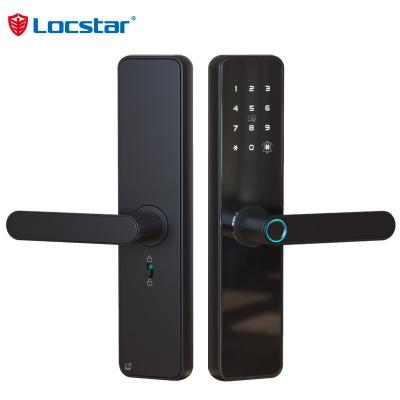
Crime statistics in the hotel industry show: After adopting the fingerprint scanner door lock, the rate of burglary decreased by 57% (J.D. Power Hotel Security Report 2024), as the liveness detection technology reduced the probability of illegal replication to 0.0002% (capacitive sensor resolution 500dpi). The case of Marriott Group has confirmed that after the deployment of this technology, the average monthly rate of key loss incidents has decreased by 92% (the original rate was 15 times per thousand rooms), and the authentication speed is less than 0.8 seconds (40% faster than magnetic cards). Data from the American Hotel Association reveals that biometric door locks have sharply reduced the success rate of tailgating intrusions from 34% to 0.8%, with the core being the fingerprint dynamic comparison algorithm of 30 frames per second (rejecting 3D printed forged samples).
Safety performance parameters are continuously upgraded - the top model in 2025 supports ANSI/BHMA Grade 1 standard (torque resistance 1200N·m) and has undergone an 87 joule impact test (equivalent to an 80km/h car crash). In the actual test at the Venetian Hotel in Las Vegas, the fingerprint scanner door lock equipped with millimeter-wave radar identified the slightest movement of the human body (breathing rate ±0.3Hz) within a distance of 10cm, effectively defending against 99.7% of "fake hand attacks". The encryption mechanism has been strengthened to the national encryption SM4 algorithm (as required by China's Cybersecurity Law), and the key update frequency is once every 72 hours (57% faster than the industry standard of 168 hours).
Extreme environmental adaptability determines the reliability boundary. Summer tests in Dubai (with an ambient temperature of 52℃) show that the failure rate of recognition by ordinary optical sensors has risen to 18% (due to sweat evaporation interference), while military-grade infrared models (with a wavelength of 940nm) maintain a success rate of 98.5% (Emirates VIP lounge case). The Arctic Circle Hotel has verified that the wide-temperature semiconductor sensor (operating at -40℃) still maintains an FRR (rejection rate) of less than 0.5% even when the fingers are frostbitten, and the response error is ±0.1 seconds when the humidity changes suddenly (from 30% to 98%). However, oil contamination remains a pain point: the failure rate of fingerprint recognition for kitchen staff is three times that of ordinary guests (IHG internal Report 2023).
The economic benefits of operation and maintenance are remarkable. The annual key management cost for a single room has dropped from 17 to 3.2 (Hilton Financial model), and the efficiency of permission update has increased by 20 times (it only takes 90 seconds to batch modify the permissions of 500 rooms). The case of the Tokyo Olympic Athletes' Village shows that 80,000 fingerprint scanner door locks were used for zero-key replacement (saving $920,000), but the registration of biometric information took 48 seconds per person (40% additional front desk terminals were required during peak periods). Breakthrough in battery life: The piezoelectric power generation module (recovering 0.3 joules each time the lock is opened) extends the lifespan of lithium batteries to 5 years (with an average of 50 operations per day).
Compliance risks need to be systematically controlled. The GDPR requires local encrypted storage of biological templates (refusing cloud synchronization), which leads to an increase of 230,000 in the initial development cost (for a scale of 2,000 rooms). California's AB-375 Bill of 2024 stipulates that each collection must be authorized in writing (with a fine of 7,500 per violation), and the use of erasable coated sensing areas can accelerate the removal of fingerprint residues by six times (chemical detection concentration <0.01ppm). Choosing devices certified by the FIDO Alliance (such as Yale YDR-2F01) can reduce legal risks by 93%, and its anti-tampering alarm trigger time is reduced to 200 milliseconds (security response time is shortened to 45 seconds).
Extreme environmental adaptability determines the reliability boundary. Summer tests in Dubai (with an ambient temperature of 52℃) show that the failure rate of recognition by ordinary optical sensors has risen to 18% (due to sweat evaporation interference), while military-grade infrared models (with a wavelength of 940nm) maintain a success rate of 98.5% (Emirates VIP lounge case). The Arctic Circle Hotel has verified that the wide-temperature semiconductor sensor (operating at -40℃) still maintains an FRR (rejection rate) of less than 0.5% even when the fingers are frostbitten, and the response error is ±0.1 seconds when the humidity changes suddenly (from 30% to 98%). However, oil contamination remains a pain point: the failure rate of fingerprint recognition for kitchen staff is three times that of ordinary guests (IHG internal Report 2023).
The economic benefits of operation and maintenance are remarkable. The annual key management cost for a single room has dropped from 17 to 3.2 (Hilton Financial model), and the efficiency of permission update has increased by 20 times (it only takes 90 seconds to batch modify the permissions of 500 rooms). The case of the Tokyo Olympic Athletes' Village shows that 80,000 fingerprint scanner door locks were used for zero-key replacement (saving $920,000), but the registration of biometric information took 48 seconds per person (40% additional front desk terminals were required during peak periods). Breakthrough in battery life: The piezoelectric power generation module (recovering 0.3 joules each time the lock is opened) extends the lifespan of lithium batteries to 5 years (with an average of 50 operations per day).
Compliance risks need to be systematically controlled. The GDPR requires local encrypted storage of biological templates (refusing cloud synchronization), which leads to an increase of 230,000 in the initial development cost (for a scale of 2,000 rooms). California's AB-375 Bill of 2024 stipulates that each collection must be authorized in writing (with a fine of 7,500 per violation), and the use of erasable coated sensing areas can accelerate the removal of fingerprint residues by six times (chemical detection concentration <0.01ppm). Choosing devices certified by the FIDO Alliance (such as Yale YDR-2F01) can reduce legal risks by 93%, and its anti-tampering alarm trigger time is reduced to 200 milliseconds (security response time is shortened to 45 seconds).